
Political Campaign Focus Groups: A Strategic Case Study in Measuring Voter Sentiment (2026)

Updated: Jun 18
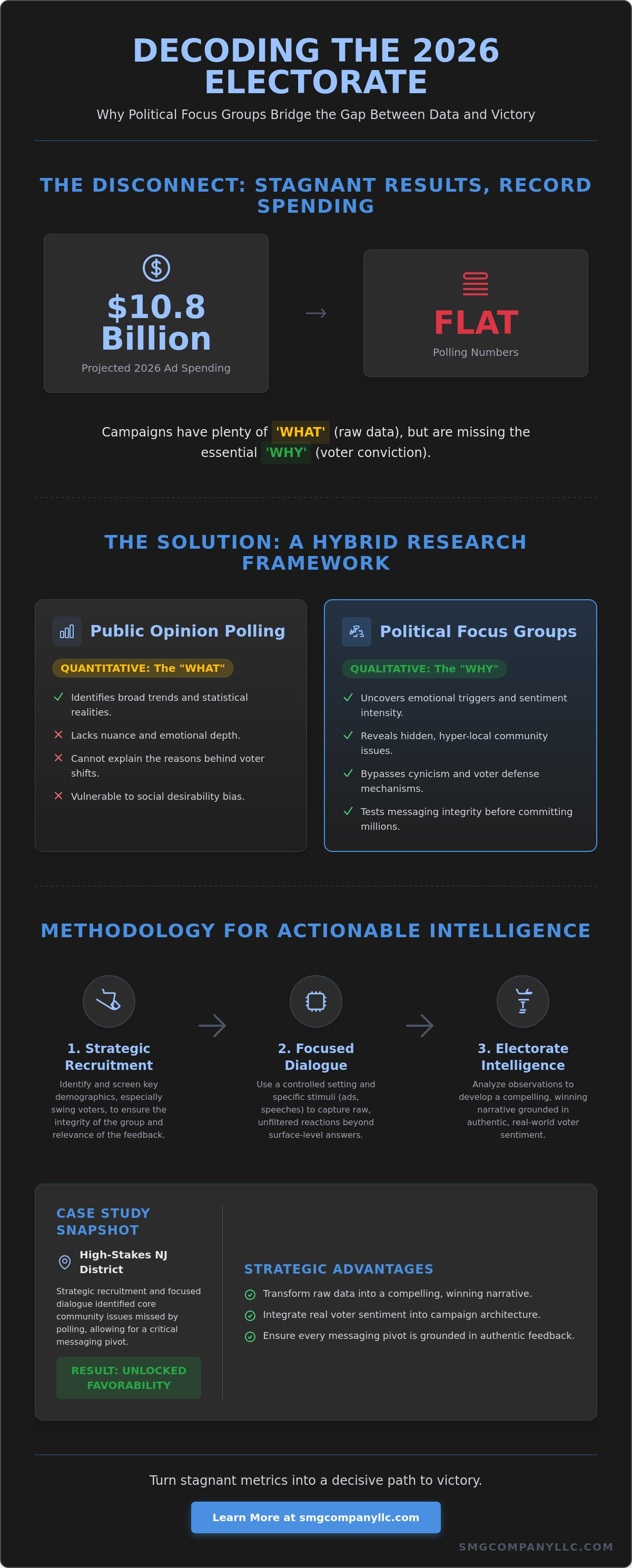
In an election cycle where total ad spending is projected to hit a record $10.8 billion, the most dangerous assumption a strategist can make is that a data point is the same thing as a voter's conviction. You've likely seen the disconnect firsthand; polling numbers remain flat despite aggressive spending, and your digital ads elicit reactions you didn't anticipate. It's a common frustration in the 2026 cycle to have plenty of "what" but almost no "why," which is why sophisticated political campaign focus groups have become the essential tool for diagnosing voter sentiment.
We understand that raw data identifies the problem, but it rarely provides the solution. This article provides a detailed roadmap for integrating qualitative research into your broader strategy to bridge the gap between metrics and winning narratives. You'll learn how to identify the specific emotional triggers of swing voters and execute messaging pivots that resonate with the 71% of adults planning to head to the polls. We'll show you how to turn stagnant metrics into a decisive path to victory through a deeper understanding of real voter dialogue.
Key Takeaways
Identify the emotional intensity behind stagnant polling numbers to transform raw data into a compelling, winning narrative for the 2026 cycle.
Utilize political campaign focus groups to diagnose the specific triggers of swing voters, moving beyond the inherent limitations of traditional quantitative research.
Analyze a high-stakes NJ case study to see how strategic participant recruitment and focused dialogue can unlock favorability in competitive districts.
Develop a hybrid research framework that effectively prioritizes public opinion polling alongside qualitative insights to optimize strategic decision-making.
Learn to integrate qualitative electorate intelligence directly into your campaign architecture, ensuring every messaging pivot is grounded in real-world voter sentiment.
Table of Contents
Beyond the Data: Why Political Campaign Focus Groups are Essential in 2026
The Methodology of Measuring Voter Sentiment Through Focused Dialogue
Case Study: Realigning a High-Stakes NJ Campaign Through Electorate Intelligence
Focus Groups vs. Public Opinion Polling: Building a Hybrid Framework
Integrating Focus Groups into Your Strategic Campaign Architecture
Beyond the Data: Why Political Campaign Focus Groups are Essential in 2026
Quantitative polling remains a pillar of modern strategy, but it's increasingly insufficient for diagnosing the volatile undercurrents of the 2026 electorate. In a cycle defined by a projected $10.8 billion in political ad spending, the sheer volume of noise has made traditional data points less reliable. A poll might indicate a candidate's favorability is slipping, but it won't explain if that decline is rooted in policy disagreement, personal distrust, or simple digital fatigue. This is where political campaign focus groups become indispensable. They offer a strategic lens that looks past the "what" of voter behavior to uncover the "why."
To better understand this concept, watch this helpful video:
Strategic architects use these sessions to move beyond broad demographic targets. Instead, they identify psychological archetypes that define the modern voter. By observing real-time reactions to messaging, campaigns can validate their electorate analysis and ensure their narrative isn't just seen, but felt. A sophisticated focus group methodology allows a campaign to test the structural integrity of its platform before committing millions to digital and mobile advertising.
The Qualitative Gap in Modern Polling
A 2% shift in a survey can't tell you if voters are genuinely angry or just bored with the current news cycle. This lack of nuance creates a qualitative gap that can lead to catastrophic messaging errors. Small-group interaction possesses a unique diagnostic power in political science; it acts as an emotional MRI of the campaign. To delve deeper into these psychological drivers using professional software, check out Ergoneers for advanced behavioral research solutions. It reveals the hidden issues that don't appear on standard survey scripts, such as subtle shifts in community leadership or hyper-local concerns that haven't reached the mainstream press. When you understand the intensity of an emotion, you can craft a response that actually moves the needle.
2026 Voter Psychology: The Era of Distrust
Digital saturation has fundamentally altered how the 2026 voter processes information. Constant exposure to AI-generated content and streaming ads has fostered a deep sense of cynicism. This environment often triggers social desirability bias, where voters provide the "correct" answer to a pollster while harboring entirely different intentions. Focus groups bypass this defense mechanism through facilitated dialogue. In high-stakes regions like Newark and across New Jersey, local context is everything. Understanding the specific vocabulary and priorities of these communities allows for an authentic storytelling approach that feels grounded and respectful rather than manufactured and distant.
The Methodology of Measuring Voter Sentiment Through Focused Dialogue
Measuring voter sentiment requires more than a casual discussion; it is a structured, scientific exercise designed to extract actionable intelligence. We use benchmark polls and focus groups in tandem to ensure that qualitative feedback is grounded in statistical reality. In a controlled setting, we observe how individuals react to specific stimuli, such as a draft speech or a digital ad. This environment allows us to capture raw, unfiltered reactions that a phone survey simply cannot replicate. By observing these interactions, we move beyond what voters say they believe to discover what actually drives their behavior.
Strategic Recruiter Selection and Screening
Successful political campaign focus groups rely entirely on the integrity of the recruitment process. We prioritize understanding swing voters because they represent the margin of victory in competitive New Jersey districts. We employ a double-blind recruitment method to ensure participants have no prior knowledge of the candidate or the specific campaign. This prevents them from providing biased or socially desirable answers. To build a representative cross-section, our screening criteria focus on specific variables:
Geographic tension between urban centers like Newark and surrounding suburban wards.
Media consumption habits, specifically distinguishing between traditional broadcast viewers and CTV streamers.
Historical voting patterns in midterm cycles versus high-turnout general elections.
The Moderator’s Playbook: Probing for Truth
Moderation is the bridge between a simple conversation and a high-level strategic diagnostic. A skilled moderator uses projective techniques, such as word association or hypothetical scenarios, to uncover motivations that voters might feel uncomfortable expressing directly. Managing dominant personalities is critical to the process. The moderator must ensure the quietest person in the room has as much influence on the data as the loudest. A script provides the structure, but the unscripted follow-up question is where a campaign discovers the truth behind a voter’s silence.
Beyond the spoken word, we analyze non-verbal cues. A furrowed brow during a video clip or a defensive posture when a specific policy is mentioned often reveals more than a verbal critique. By utilizing reaction testing for digital assets, we can identify which visual elements trigger distrust before the first dollar is spent on airtime. This level of precision is why leading campaigns rely on a comprehensive management partner to oversee their research architecture and messaging strategy.
Case Study: Realigning a High-Stakes NJ Campaign Through Electorate Intelligence
Data often creates a false sense of security for established candidates. In one high-stakes New Jersey campaign, a candidate entered the final quarter with nearly universal name recognition but stagnant favorability ratings. The numbers didn't move despite a heavy investment in broadcast media. To solve this, we deployed three targeted political campaign focus groups across key Newark wards. This research wasn't meant to predict the final outcome, which is a common misuse of focus groups in politics, but rather to diagnose the specific friction points in the candidate's delivery.
Identifying the Messaging Friction Point
Our preliminary voter data analysis flagged a clear anomaly: voters agreed with the candidate's core infrastructure policy but reacted with visible skepticism whenever he spoke about it on camera. During the sessions, one participant noted that it sounded like the candidate was reading a press release rather than talking to his neighbors. This was the breakthrough. Voters didn't oppose the policy; they distrusted the clinical, overly polished delivery. By listening for the silence, those moments where participants checked out or crossed their arms, we realized the campaign's formal vernacular was alienating the very people it sought to serve.
From Insight to Execution: The Strategic Messaging Shift
We immediately re-wrote the campaign narrative, stripping away the jargon and replacing it with the authentic vernacular we heard in the Newark sessions. These qualitative insights were directly integrated into our digital advertising for campaigns, shifting the creative focus from high-gloss production to raw, direct-to-camera addresses. This wasn't a change in position, but a change in posture that reflected the community's own language and concerns.
The SMG Video Truck played a pivotal role in this realignment. We deployed the truck to high-traffic areas in Newark, broadcasting the revised messaging in the heart of the community. This wasn't just about reach; it was about presence and local accountability. The result was a measurable shift in momentum. Follow-up tracking polls confirmed that the pivot worked, leading to a 7-point swing in favorability during the final 30 days of the election. By using political campaign focus groups as a diagnostic tool rather than a crystal ball, the campaign moved from a defensive posture to a decisive victory.
Focus Groups vs. Public Opinion Polling: Building a Hybrid Framework
Polling identifies the trend, but political campaign focus groups explain the motive. Relying solely on one research medium creates a strategic blind spot that can lead to misallocated resources and ineffective messaging. While quantitative data tells you that 42% of a target district is undecided, it cannot explain that those voters are specifically waiting for a candidate to address local utility costs before they commit. Integrating qualitative insights with public opinion polling services creates a hybrid framework that eliminates the guesswork from high-stakes decision making. This dual-track approach ensures your campaign isn't just following the numbers, but leading the conversation.
Quantitative Breadth vs. Qualitative Depth
The 2026 cycle demands a nuanced understanding of how to balance these two methodologies. In a limited budget environment, the sequence of your research determines its efficiency. It's often more productive to conduct focus groups early to "stress test" the themes and language that will eventually form the basis of your larger surveys. This prevents the campaign from spending its entire research budget on a poll that asks the wrong questions. The following table highlights the structural differences between these two essential tools:
Stress-Testing Your Political Messaging
Focus groups act as the ultimate filter for political messaging services. We use these sessions to A/B test speech drafts and ad scripts in a live environment, allowing us to see which phrases trigger engagement and which cause a room to go cold. This process is vital for preventing the "tone-deaf" campaign errors that occur when a candidate talks to themselves rather than the electorate. Observing a voter's physical reaction to a specific policy proposal provides more strategic clarity than a thousand anonymous survey responses. To align your campaign's narrative with the real-world sentiment of your district, explore our comprehensive campaign management solutions today.
Integrating Focus Groups into Your Strategic Campaign Architecture
Research is only as valuable as its application. At SMG, we don't view qualitative data as a static report; we treat it as a living component of a broader campaign management architecture. This data informs every decision from speech writing to the precise timing of digital & mobile advertising. Effective political campaign focus groups serve as the connective tissue between high-level messaging and boots-on-the-ground execution. When we understand the emotional drivers of a district, we can tailor field operations and GOTV efforts to speak directly to the voter's primary concerns, ensuring our ground game is as persuasive as our media buy.
Local expertise is the final piece of the puzzle. Interpreting voter sentiment in Newark or across New Jersey requires a deep understanding of the state's unique political ecosystem and community leadership structures. We don't just listen to what participants say; we analyze how their feedback aligns with the local power dynamics we've navigated for decades. This insight doesn't lose its value on election night. The same electorate intelligence that wins a campaign provides the foundation for a long-term government relations strategy, allowing elected officials to maintain a clear line of communication with their constituents well into their term.
From Insight to Action: The Full-Service Lifecycle
SMG bridges the gap between the research room and the ballot box by maintaining a full-service lifecycle for every project. Our firm has applied these strategic principles in 40+ states, but our roots in New Jersey give us a distinct advantage in the state's most competitive wards. The presence of seasoned leadership like Lionel Leach ensures that these dialogues are interpreted through a lens of actual power dynamics and community influence, rather than just academic theory. We take the "why" uncovered in political campaign focus groups and translate it into a "how" for your entire campaign team. This ensures that every voice and text broadcast reflects the authentic concerns of the community.
Securing Your Strategy for the 2026 Cycle
A winning strategy for the 2026 cycle requires a methodical research calendar. We recommend a progression that begins with benchmark public opinion polling to define the battlefield, followed by focus groups to refine the narrative, and concluding with tracking polls to monitor shifts in sentiment. The cost of "not knowing" is far higher than the investment in research. In a cycle where $10.8 billion will be spent on political ads, being wrong about your message is an expensive failure that most campaigns can't afford. Qualitative research is a preventative investment that protects your budget from being wasted on tone-deaf content. To ensure your narrative is built on a foundation of real-world intelligence, partner with SMG for your 2026 strategic research needs and secure your path to victory.
Mastering the Narrative Architecture of 2026
Quantitative data provides the skeleton of a campaign, but qualitative insight provides the pulse. We've explored how a hybrid framework allows strategists to stress-test messaging and bypass the digital fatigue of the modern voter. By moving beyond raw numbers, political campaign focus groups uncover the specific emotional triggers that drive action at the ballot box. This methodology ensures your campaign narrative is both authentic and precise, protecting your budget from the high cost of misaligned messaging. It's not just about knowing what voters think; it's about understanding why they act.
Successful campaigns require an expert who understands the hidden mechanics of influence and knows how to build a path to victory. With experience in 40+ states and strategic leadership by Lionel Leach, SMG offers full-service integration that connects research to digital ads and campaign management. We provide the clarity needed to navigate complex systems where others only see obstacles. Secure Your Strategic Advantage with SMG’s Research Services and lead your community with confidence. Your path to a decisive win begins with a deeper understanding of the people you serve.
Frequently Asked Questions
How many people are typically in a political campaign focus group?
A standard focus group typically consists of 8 to 12 participants. This specific size allows for a manageable dialogue where every individual has the opportunity to contribute while providing enough diversity of thought to identify recurring themes. If a group is too small, a single dominant personality can easily skew the results; if it's too large, the moderator cannot probe deeply into individual motivations or emotional triggers.
Can focus groups replace traditional public opinion polling?
Focus groups don't replace traditional public opinion polling; instead, they provide the qualitative depth that quantitative data lacks. Polling is designed to measure the breadth of support across a large population to establish statistical trends. Focus groups are diagnostic tools used to understand the "why" behind those numbers. A successful campaign uses a hybrid framework where polling identifies a problem and focus groups develop the strategic solution.
How much does a professional political focus group cost to run?
The investment required for a professional focus group project varies significantly based on the number of sessions, geographic location, and the complexity of the participant recruitment. Factors such as facility rentals, professional moderation, and participant incentives all influence the total cost. Campaigns should evaluate their research needs early in the cycle to ensure that qualitative studies are properly integrated into the overall strategic budget without compromising depth.
What is the best time in a campaign cycle to conduct focus groups?
The most effective times to conduct political campaign focus groups are during the initial narrative development phase and the final messaging pivot window. Early sessions help a campaign test core themes and policy positions before they are finalized for the public. Later in the cycle, these groups are essential for troubleshooting stagnant polling numbers or testing the effectiveness of digital ads against a specific segment of swing voters.
How do you ensure focus group participants are telling the truth?
Truthfulness is ensured through professional moderation techniques and a double-blind recruitment process. Skilled moderators use projective techniques, such as word association or hypothetical scenarios, to bypass social desirability bias. This allows participants to express their genuine feelings rather than the answers they believe are socially expected. Double-blind screening ensures that participants have no prior knowledge of the candidate, preventing pre-existing bias from influencing the dialogue.
What is the difference between a focus group and a town hall meeting?
A focus group is a controlled research environment, whereas a town hall is a public engagement event. Town halls are designed for transparency and community outreach, often featuring a candidate speaking to a large, unvetted audience. In contrast, political campaign focus groups are private, moderated sessions with a representative cross-section of voters. The goal is data collection and message refinement rather than public relations or direct voter persuasion.
Can focus groups be conducted virtually for political research?
Virtual focus groups are a highly effective and increasingly popular option for modern political research. They eliminate travel costs and allow campaigns to reach voters in geographically dispersed or remote areas with high efficiency. While virtual sessions might lose some subtle physical cues, they often encourage more candid responses from participants who feel comfortable in their own environments. This method is particularly useful for rapid-response testing of digital and mobile advertising.
How do you translate focus group findings into actual campaign ads?
Findings are translated into ads by identifying the specific vernacular and emotional triggers that resonated most with participants during the sessions. Strategists look for recurring phrases or shared concerns that emerged naturally in conversation. This language is then integrated into speech writing and messaging scripts to ensure the campaign sounds authentic to the target electorate. By using the voters' own words, the campaign builds a narrative that feels grounded and respectful.
Comments