
Voter Data Analysis in 2026: A Strategic Guide to Electorate Intelligence

Updated: Jun 18
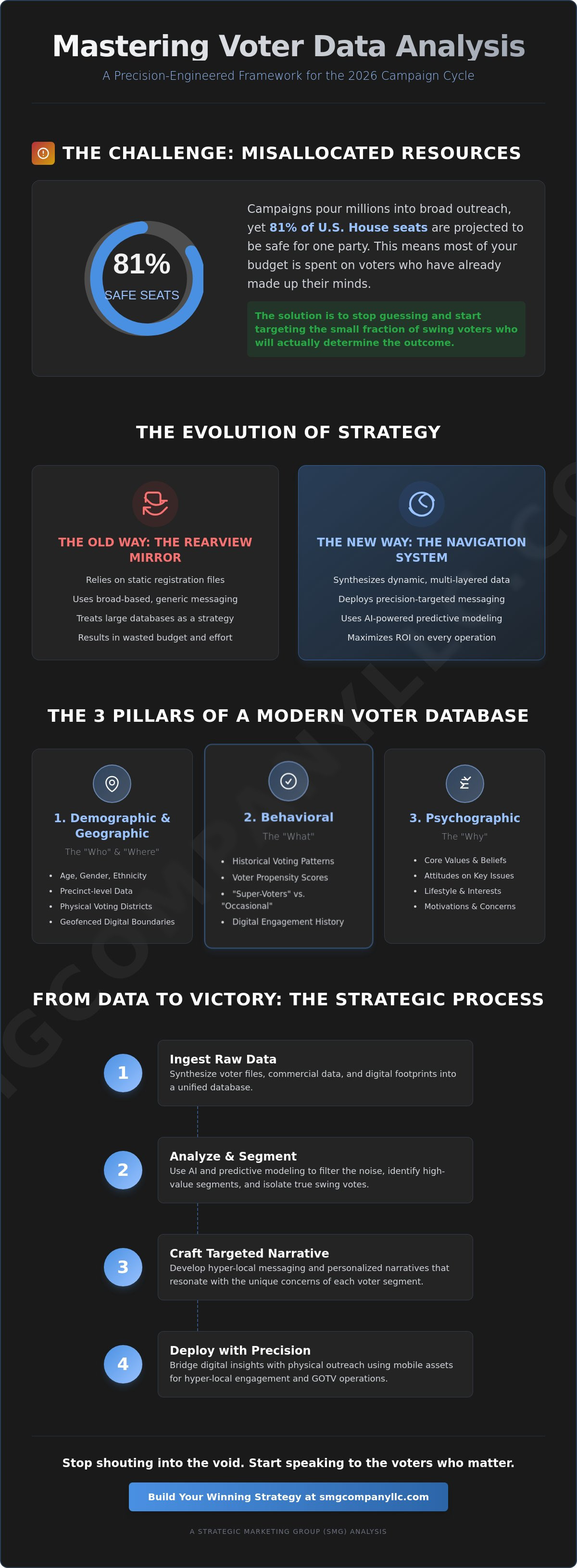
Why are campaigns still pouring millions into broad outreach when 81 percent of U.S. House seats are projected to be safe for one party in 2026? You've likely felt the frustration of staring at a massive voter file, knowing that somewhere in those rows of data lies the key to the swing vote, yet you're currently burning your budget on people who've already made up their minds. It's a common struggle to manage thousands of records while trying to execute effective voter data analysis that identifies the specific citizens who will actually determine the outcome.
This guide will show you how to master these fundamentals to stop the waste and transform raw numbers into a precision-engineered campaign strategy. We'll explore a clear framework for voter segmentation, analyze the impact of recent legislative shifts across 41 states, and build a data-backed path to victory that maximizes your ROI on every digital and field operation. By the end of this article, you'll understand how to deconstruct the hidden mechanics of influence to secure a win in an increasingly rigid political environment.
Key Takeaways
Understand why modern voter intelligence requires a synthesis of demographic, behavioral, and psychographic data rather than simple registration lists.
Master the core pillars of voter data analysis to identify high-value segments and isolate the true swing votes in your district.
Use predictive modeling and look-alike audiences to find new supporters who share the values of your most loyal base.
Learn the step-by-step process of converting raw datasets into a winning narrative through targeted messaging and strategic segmentation.
Discover how to bridge the gap between digital insights and physical outreach by using mobile assets for hyper-local engagement.
Table of Contents
The Evolution of Voter Data Analysis in 2026
Voter data analysis in 2026 represents a departure from the traditional reliance on static registration files. It's no longer enough to possess a list of names; modern strategy requires a sophisticated synthesis of demographic, behavioral, and psychographic data. This evolution replaces the "voter list" with a dynamic map of human intent. Predictive modeling now allows us to anticipate shifts in sentiment before they manifest at the ballot box. It's the difference between looking in a rearview mirror and using a high-definition navigation system.
To visualize how data can be processed for election results, watch this helpful demonstration:
Why Raw Data Is Not a Strategy
Many campaigns mistake a large voter database for a strategy. This is a costly error. Raw data is often just noise that obscures the path to victory. Strategic interpretation is the filter that identifies the "signal." This is why electorate analysis is the bedrock of any successful operation. It provides the context needed to understand why a specific segment of the community is hesitant to engage or eager to flip. Without this foundation, you're simply guessing with a larger budget.
The Role of Technology in Modern Electorate Intelligence
Technology has fundamentally changed the accessibility of high-level intelligence. AI and machine learning now drive voter modeling with unprecedented speed. These advancements aren't limited to national stages. Cloud computing has democratized these tools, allowing candidates in local New Jersey council or mayoral races to leverage sophisticated analytics once reserved for presidential contenders. In a fast-moving political environment where laws and sentiments shift weekly, real-time data updates aren't a luxury. They're a requirement for survival.
The shift toward precision-targeted strategic communications is absolute. Broad-based messaging belongs to a previous century. Today, success depends on identifying the exact intersection of voter concern and candidate capability. When you understand the hidden mechanics of influence through rigorous voter data analysis, you stop shouting into the void. You start speaking directly to the voters who matter most, ensuring every resource is deployed with maximum impact.
Core Components of a Modern Voter Database
A modern voter database is no longer a static collection of mailing addresses. It's a high-fidelity digital twin of the electorate. To execute effective voter data analysis, strategists must integrate three distinct pillars: demographic, behavioral, and psychographic data. These layers provide the resolution necessary to move beyond broad assumptions. While state registries offer the legal framework of the electorate, commercial vendors and digital footprints provide the texture. Integrating these disparate sources requires a commitment to data hygiene. For instance, on March 20, 2026, the American National Election Studies identified issues with several variables in their 2024 data, reminding us that even the most reputable sources require constant verification.
Demographic and Geographic Layering
Understanding the "who" and "where" is the first step in establishing base support. In high-stakes environments like New Jersey council or mayoral races, precinct-level geographic data is the currency of victory. Strategists utilize advanced election analysis techniques to layer ethnicity, age, and gender data over specific physical voting districts. This precision allows for the deployment of geofencing. By drawing digital boundaries around specific precincts, a campaign can serve hyper-local messaging that resonates with the unique concerns of that neighborhood. This ensures that resources aren't wasted on voters outside the target area.
Behavioral and Historical Voting Patterns
Voter propensity remains the most reliable predictor of future action. It's vital to distinguish between "super-voters" who never miss a cycle and "primary-only" or "general-only" participants. In 2026, the legislative landscape is shifting rapidly. With at least 9 states enacting restrictive voting laws as of May 1, 2026, understanding how these changes affect historical patterns is critical. Analyzing past donor behavior also serves as a powerful indicator of political engagement. When a voter has a history of financial contribution, their likelihood of showing up to the polls increases significantly. This behavioral data allows campaigns to prioritize outreach toward those most likely to cross the finish line.
Maintaining a competitive edge in 2026 also requires navigating the new landscape of data compliance. With lawmakers in 41 states considering over 300 restrictive voting bills, the rules for how data is gathered and utilized are in constant flux. A seasoned strategist ensures that every file is not only accurate but also compliant with the latest state-level mandates. This rigorous approach to data management transforms a simple list into a strategic asset. For those looking to refine their outreach, integrating these insights into political messaging services is the final step in bridging the gap between data and persuasion.
Advanced Methodologies: Segmentation and Modeling
Raw data remains inert until it's subjected to rigorous modeling. In a cycle where 81 percent of U.S. House seats are projected as safe for one party, the margin for error in competitive districts is nonexistent. Sophisticated voter data analysis moves beyond basic sorting to identify look-alike audiences. These are individuals who don't yet appear on your supporter list but share the psychographic and behavioral traits of your most loyal base. By integrating campaign analytics, strategists can move from broad outreach to microtargeting, ensuring that the right message reaches the right screen at the right time.
Predictive modeling allows a campaign to simulate various outcomes based on shifting variables. If turnout in a specific demographic drops by three percent, the model reveals which secondary segment must be activated to compensate. This level of foresight transforms a campaign from a reactive entity into a proactive force. It's about building a strategic architecture that anticipates the "hidden" mechanics of influence rather than merely responding to them.
Identifying and Segmenting the Swing Vote
Isolating the undecided voter in high-stakes Newark or statewide contests is a surgical operation. Issue-based segmentation is the primary tool for this task. With 2026 voters citing government corruption at 40.4 percent and healthcare costs at 39.1 percent as top concerns, campaigns must group voters based on these specific anxieties. Understanding swing voters requires more than knowing they're "undecided." It involves identifying the specific value or policy that will serve as their tipping point. This data-backed segmentation creates a clear "Path to 50%+1" by focusing resources on the narrow slice of the electorate that is actually capable of moving.
Sentiment Analysis and Public Opinion
Data engines require high-quality fuel, which is provided by public opinion polling services. Modern sentiment analysis goes beyond measuring the direction of an opinion; it measures the intensity. A voter who "somewhat" supports a candidate requires a different engagement strategy than one who is "strongly" committed. Benchmark polling sets the baseline, but ongoing tracking polls allow for real-time adjustments as news cycles break. Focus groups then serve to validate these data-driven assumptions, providing the qualitative nuance that raw numbers sometimes miss. This combination ensures the campaign narrative isn't just statistically sound, but emotionally resonant with the community's current pulse.
Actionable Guidance: Turning Data Into a Winning Narrative
Transforming raw intelligence into a persuasive story requires a methodical transition from the spreadsheet to the street. The most sophisticated voter data analysis is useless if it doesn't inform the words spoken on a doorstep or the pixels displayed on a smartphone. This process begins by defining core electorate segments based on the behavioral and psychographic pillars established in previous phases. Once these groups are isolated, the campaign must develop tailored messaging via political messaging services that address specific anxieties. For example, with 39.1 percent of voters currently preoccupied with healthcare costs, a generic economic message will likely fail to resonate. You must understand the hidden mechanics of influence to turn these numbers into a winning strategy.
Execution follows a five-step progression to ensure no resource is squandered in a cycle where 81 percent of House seats are already projected as safe. First, define your electorate segments by values, propensity, and likelihood to flip. Second, architect distinct narratives for each group to ensure maximum relevance. Third, deliver these narratives through high-impact channels where those specific voters consume information. Fourth, maintain continuous monitoring through tracking polls to measure narrative penetration and adjust as the cycle evolves. Finally, execute precision GOTV efforts targeting only those individuals identified in the turnout model as essential for your Path to 50%+1.
Microtargeting and Digital Deployment
Success in 2026 depends on reaching diverse urban demographics through their primary devices. Utilizing digital advertising for campaigns allows for the surgical placement of content within specific geofenced precincts. This precision-engineered approach to voter data analysis ensures that a voter in a Newark high-rise receives a different, more relevant message than a suburban homeowner. This mobile-based outreach bridges the gap between broad digital awareness and hyper-local field operations, preventing budget waste on broad, untargeted outreach.
Crisis Mitigation Through Data
Data serves as an early warning system. Real-time monitoring allows a campaign to identify negative narratives before they achieve viral velocity. By measuring attack impact on specific segments, leadership determines if a response is necessary. This data-driven reputation management prevents reactive blunders. Secure your strategic advantage by consulting with our campaign management team to build a resilient infrastructure.
The SMG Advantage: Strategic Architecture for 2026
SMG stands as the strategic architect for the 2026 cycle. While many firms provide spreadsheets, we provide the path to victory. Our firm bridges the gap between raw numbers and actual influence. With deep roots in New Jersey and a footprint spanning over 40 states, we understand the nuances of local engagement and national trends. We don't just sell services; we manage the hidden mechanics of power through sophisticated voter data analysis. We pride ourselves on being a disruptive force that challenges the status quo by looking at social trends through a lens of deep-rooted expertise and high-stakes success.
Our approach to voter data analysis isn't confined to a computer screen. We deploy innovative mobile assets like the SMG Video Truck to bring targeted messaging directly into the precincts identified by our models. When the data indicates a specific neighborhood is a critical swing area, we don't just hope they see a digital ad. We place our high-impact mobile assets exactly where those voters live and work. This synthesis of high-level intelligence and physical presence is what sets our campaign management and government relations strategy apart from competitors who rely solely on digital impressions.
Beyond the Spreadsheet: Integrated Campaigning
True victory requires a single, unified strategy. We integrate public opinion polling, digital advertising, and field operations into a cohesive mission. Software alone cannot win an election. It takes a seasoned insider to interpret the complexities of the 2026 electorate. We look at data through a lens that respects civic duty and community leadership. Our goal is to build a movement that is both intellectually formidable and socially rooted. By combining speech writing and messaging with voice and text broadcasting, we ensure your narrative is consistent across every touchpoint of the campaign.
Ready to Lead in 2026
The 2026 election cycle is already moving. Lawmakers in 41 states have considered hundreds of restrictive and expansive voting bills as of May 1, 2026. You cannot afford to wait until the final months to secure your strategic foundation. SMG has a proven track record of success, from local mayoral races to the halls of Congress. We invite you to contact us for a comprehensive consultation. Let us build the data-backed path to victory that your organization requires. Secure your position as a leader in the community by partnering with a firm that understands the gravity of the field and the precision required for success.
Securing Your Strategic Foundation for 2026
The path to victory in 2026 requires more than a standard voter file; it demands a sophisticated understanding of the hidden mechanics of influence. By mastering voter data analysis, you've moved beyond broad, untargeted outreach to a precision-engineered campaign strategy. You now possess the framework to isolate the swing vote and deploy narratives that resonate with the specific anxieties of your district. Success in this rigid political climate is not accidental. It's the result of a methodical, data-driven approach to leadership.
SMG brings a history of high-stakes success to every engagement. With experience in over 40 states and deep-rooted expertise in New Jersey political and labor leadership, we serve as the strategic architect for your organization. Our innovative use of the SMG Video Truck ensures that your data-backed narrative reaches the community with maximum physical impact. We understand how to navigate complex systems and build a path to victory where others see only obstacles.
Partner with SMG for your 2026 campaign strategy to establish your competitive edge now. We're ready to lead the way.
Frequently Asked Questions
What is voter data analysis, and why is it important for small campaigns?
Voter data analysis is the strategic synthesis of demographic, behavioral, and psychographic information to understand and predict voter intent. For small campaigns, this intelligence is vital because it prevents the waste of limited resources on broad, untargeted outreach. By identifying exactly which citizens are likely to engage or flip, local candidates can compete with better-funded opponents through precision rather than volume.
How do political consultants collect and use voter data legally in 2026?
Consultants utilize official state registries, commercial vendors, and opt-in digital records to construct their datasets. Legality in 2026 requires strict adherence to a shifting landscape of state laws. As of May 1, 2026, lawmakers in 41 states have considered over 300 restrictive voting bills. Professional firms ensure all data acquisition and usage comply with these evolving regulatory frameworks to protect the campaign's integrity and standing.
Can voter data analysis help identify swing voters in local New Jersey elections?
Yes, this analysis is particularly effective in New Jersey's nuanced local districts. By applying issue-based segmentation, strategists can isolate undecided voters who are concerned with specific regional topics such as healthcare costs or government corruption. This allows a mayoral or council candidate to focus their messaging on the narrow slice of the electorate that is actually capable of shifting the final tally in a competitive race.
What is the difference between a voter file and a predictive model?
A voter file is a static list containing registered individuals and their basic participation history. A predictive model is a dynamic tool that uses that file to forecast future behavior. While the file tells you who a person is, the model suggests how they will likely vote or respond to a specific message based on their shared traits with known supporters and look-alike audiences.
How much does professional voter data analysis typically cost for a state-level campaign?
The investment required for professional analysis varies based on the depth of the data and the complexity of the modeling. Factors such as the size of the electorate and the frequency of real-time updates will influence the final scope. Organizations should consult with strategic partners to receive a customized assessment that aligns with their specific district size and the intensity of the contest.
How often should a campaign update its voter data to ensure accuracy?
Campaigns should update their data at regular intervals to maintain accuracy in a fast-moving political environment. With the U.S. Election Assistance Commission releasing new datasets as recently as February 12, 2026, relying on outdated files is a strategic risk. Regular maintenance ensures that changes in registration status or residency don't compromise the effectiveness of your field and digital operations.
What role does digital behavior play in modern electorate analysis?
Digital behavior serves as the modern psychographic layer of voter data analysis. It reveals a voter's current anxieties and interests through their interaction with online content and mobile devices. By integrating these digital footprints with traditional records, strategists can identify look-alike audiences and deploy hyper-local messaging that resonates with the real-time concerns of the community.
Can data analysis predict the outcome of an election before it happens?
Data analysis identifies probabilities and trends rather than guaranteed outcomes. It provides a strategic map of the electorate's current state and potential movement. While it can forecast a path to victory with high accuracy, the final result depends on the campaign's ability to execute its strategy and respond to late-breaking shifts in public sentiment or legislative changes.
Comments