
NJ Healthcare Public Affairs: A Strategic Guide

What happens when a policy decision moves faster than a healthcare organization’s message? In New Jersey, the June 2026 extension of telehealth reimbursement parity through December 31, 2027, under P.L.2026, c.29, is one reminder that policy priorities can shift quickly. For leaders evaluating public affairs for healthcare organizations nj, the challenge is to understand what those shifts mean, how the public views them, and what the organization should communicate.
That challenge is familiar: government-relations efforts and public messaging can feel disconnected, while leaders need a grounded read on public sentiment before setting priorities. Effective public affairs brings these considerations together. Polling can help clarify public perspectives; government affairs strategy can frame policy priorities; and focused messaging can give the organization a coherent voice.
This guide explains how New Jersey healthcare organizations can assess which capabilities align with their goals and connect research, government affairs, and communications in one strategic approach. It also outlines a practical way to begin a discussion about organizational priorities, so leadership can move from reacting to each development toward a clearer, more deliberate plan.
Table of Contents
What public affairs means for healthcare organizations in New Jersey
How New Jersey healthcare public affairs connects policy, polling, and messaging
How to evaluate public-affairs support for a New Jersey healthcare organization
A practical planning framework for healthcare public affairs in NJ
How SMG can support public-affairs priorities for healthcare organizations
What public affairs means for healthcare organizations in New Jersey
Public affairs is the coordinated work of aligning an organization’s priorities with government engagement, public sentiment, and strategic communications. For healthcare organizations, that means considering how a policy issue may affect institutional goals and how community perspectives may shape the conversation around it. The work connects internal decision-making with the external audiences and decision-makers an organization needs to reach.
New Jersey organizations operate within a civic environment where public health priorities, community concerns, and government decisions can intersect. The broader field of public health draws on multiple disciplines and approaches, including health promotion. That context matters: a healthcare organization’s public-affairs priorities may involve explaining its position, listening to affected communities, or engaging decision-makers. The appropriate approach depends on the organization’s goals, the issue, and the audiences involved.
Policy awareness and community understanding are complementary, not interchangeable. A policy development may create a need to clarify organizational priorities, while public sentiment can help leaders understand which concerns require more attention. Neither should be treated as a substitute for the other. A strategy that considers both can help leadership make more informed choices about what to communicate, to whom, and through which channels.
Public affairs is broader than a response to a single urgent event. Crisis communications addresses a specific situation and the immediate need to communicate clearly; ongoing public-affairs strategy considers longer-term priorities, government engagement, and changing public perspectives. The two can intersect, but they serve different purposes. Building awareness before a crisis can give leaders a clearer view of the audiences, issues, and messages that may matter when circumstances change.
Which healthcare organizations may consider public-affairs support?
Health systems, healthcare associations, service organizations, and individual leaders may consider public-affairs support when a policy question or public issue intersects with their goals. A health system may need to explain an organizational priority to community members and decision-makers; an association may need to represent shared concerns across its membership. For leaders considering public affairs for healthcare organizations NJ, the starting point is to identify whose understanding or engagement is necessary to advance the organization’s purpose.
How is public affairs different from crisis communications?
Public affairs tracks the ongoing relationship between organizational priorities, policy discussions, and public sentiment. Crisis communications, by contrast, focuses on a defined event that requires a timely, coordinated response. One is a continuing strategic discipline; the other is event-specific planning and communication. An organization may need both, but a crisis plan alone won’t establish how to engage decision-makers or understand community perspectives over time.
In practice, leaders can begin by naming the decision or priority at stake, identifying the audiences who influence or experience it, and assessing what information would help guide communication. That framing keeps public-affairs work anchored to organizational purpose rather than reacting to every development with a new message. It also creates a clearer basis for deciding which strategic capabilities are relevant, a question explored in the next sections.
How New Jersey healthcare public affairs connects policy, polling, and messaging
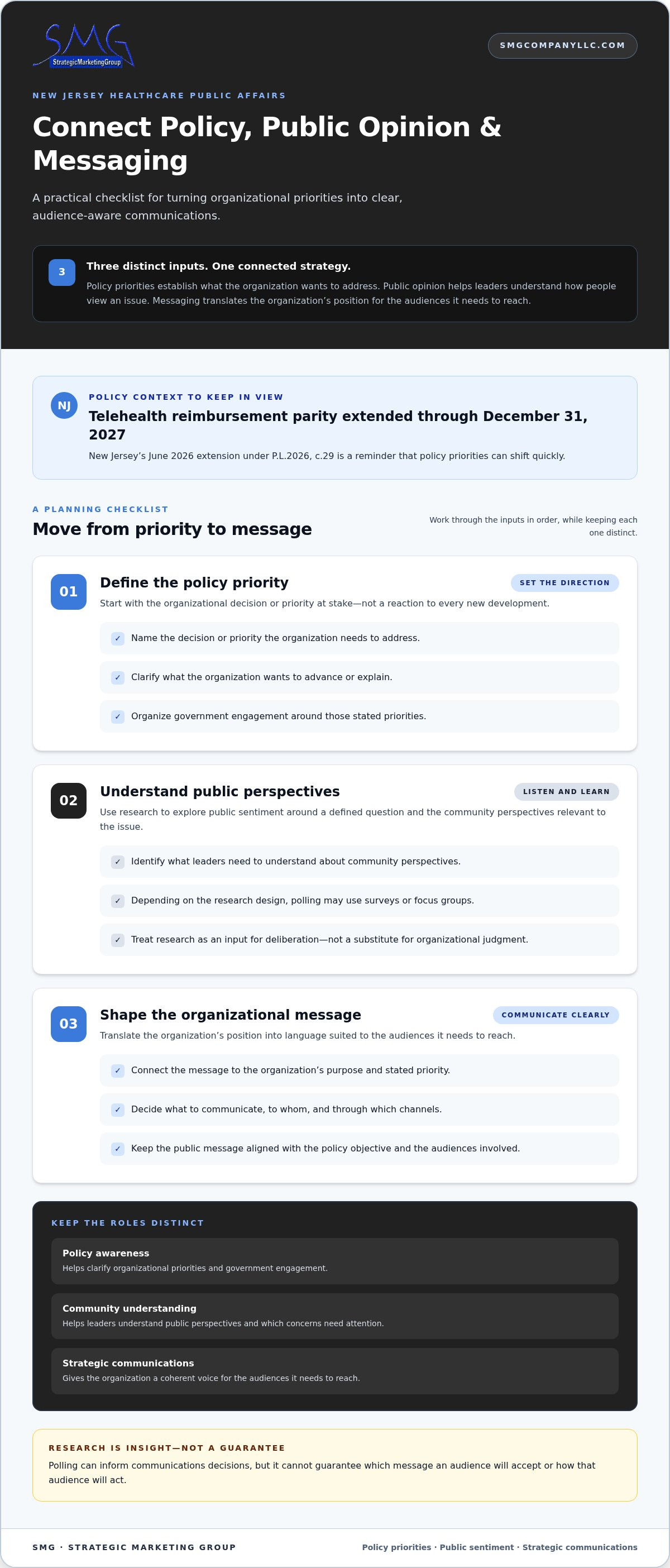
Public-affairs decisions draw on three distinct inputs: policy priorities, public opinion, and organizational messaging. Policy priorities establish what the organization wants to advance or address. Public opinion helps leaders understand how people view an issue. Messaging translates the organization’s position into language suited to the audiences it needs to reach. Treating these inputs as connected, but not interchangeable, helps leadership make clearer strategic choices.
For example, if a healthcare organization is considering how to explain a proposed initiative, leaders can first define the policy objective, then identify what they need to understand about community perspectives, and finally shape communications around the organization’s purpose. Government-affairs strategy organizes engagement around those stated priorities. In New Jersey, public information from the New Jersey Department of Health can also help organizations follow the state health context relevant to their work. These steps support planning, but don’t predetermine what the public thinks or how decision-makers will respond.
Research can inform communications decisions, but it can’t guarantee which message an audience will accept or how that audience will act. That distinction matters. Polling is a source of insight for deliberation, not a substitute for organizational judgment or a promise of a particular result.
Where public opinion polling fits
Polling can help an organization examine public sentiment around a defined question. Depending on the research design, surveys, focus groups, and analysis may provide different kinds of perspective. The value begins with the decision the organization needs to make, not with collecting data for its own sake. Leaders might ask what concerns are most important to understand before framing a public statement, or which terms audiences interpret differently. Public opinion polling services can be considered as one research capability in that process.
Before commissioning research, clarify the decision it should inform, the audience whose views matter, and how the findings will be weighed alongside policy goals. This keeps the inquiry focused and makes it easier to distinguish evidence from assumptions. The results can sharpen questions and inform message development, while leaders remain responsible for interpreting them in context.
Why government affairs and messaging should align
Government-affairs strategy gives policy priorities structure: it helps an organization determine which issues to emphasize and how engagement relates to its goals. Communications can then reflect that strategy rather than operate on a separate track. Speech/OP-ED Writing can articulate an organizational position, while Digital Advertising can support public-facing communication. The timing and framing should follow the organization’s priorities and audience needs.
For leaders assessing public affairs for healthcare organizations nj, alignment means the policy position, research questions, and public message reinforce a coherent direction without assuming a specific outcome. SMG’s public-affairs capabilities offer a starting point for discussing how polling, Government Relations Strategy, and communications may fit an organization’s priorities.
How to evaluate public-affairs support for a New Jersey healthcare organization
Start with the organizational priority, not a menu of services. Evaluate strategic fit by matching goals, audiences, and service capabilities. A useful comparison identifies what the organization needs to address, which capability relates to that need, and what evidence can support claims about experience or results. Keep confirmed descriptions of services separate from claims that require independent substantiation.
The framework below can help leadership define the discussion. “Evidence to discuss” means the material that would help assess fit, not a promise of a particular outcome.
Match the organization’s priority to the right capability
For a policy priority, Government Relations Strategy is the relevant capability to consider. For questions about public sentiment, Polling can help inform decisions without guaranteeing any particular finding. For communication, distinguish the purpose of message development from its distribution. Speech Writing & Messaging shapes content; Digital & Mobile Advertising, Mobile LED Marketing, and Voice and Text Broadcasting are separate outreach capabilities. The fit depends on the goal and audience.
Health information also requires care in how it is framed. Resources such as Harvard Health Publishing provide a point of reference for health-related content, but an organization’s messages should still reflect its own priorities and audience context.
Assess integration, experience, and geographic context
A proposed approach is more coherent when research questions inform strategic choices and communications reflect those choices. Examine whether each capability has a defined role, rather than appearing as a disconnected item. SMG reports election experience in over 40 states and activity in New Jersey, including Newark and Essex County. That geographic and election experience should not be treated as evidence of healthcare-sector engagements or outcomes.
For public affairs for healthcare organizations nj, separate what a firm demonstrably does from claims about results, client experience, or specialized expertise. A clear discussion of priorities and audiences can help establish fit. Leaders can use SMG’s public-affairs capabilities as a starting point for mapping relevant support to their organization’s objectives.
A practical planning framework for healthcare public affairs in NJ
Effective planning starts with the organization’s objectives, not a tactic or channel. Before selecting public-affairs support, leaders should define the issue, the audiences that matter, and what progress would look like in organizational terms. This keeps research and communications focused on a clear purpose rather than activity for its own sake.
Set the issue, audience, and intended outcome
Frame the issue in one sentence, then distinguish the groups involved. Decision-makers, community audiences, employees, and organizational partners may need different information. An intended outcome might be clearer understanding of a stated priority, a more informed leadership decision, or a structured approach to engagement. These are planning objectives, not guaranteed results.
Use this four-step sequence to move from a defined priority to relevant support:
Define the priority. Specify the policy or public-perception issue the organization needs to address and why it matters to its mission or plans. Keep the scope narrow enough to guide decisions.
Map the audiences. Identify decision-makers, community groups, employees, and other stakeholders. Note what each group needs to understand and what the organization needs to learn from them.
Set an organizational measure of progress. Choose an indicator the leadership team can assess, such as whether a decision is better informed or whether the organization has established a consistent message. This is a way to evaluate the plan, not a promise of public response.
Select relevant support. Match the objective to capabilities. Government Relations Strategy may suit policy engagement; Public Opinion Polling may help explore sentiment; Speech Writing & Messaging can support message development; and Digital & Mobile Advertising or Voice and Text Broadcasting may fit outreach priorities.
Choose research and communication priorities
Not every issue calls for every capability. If leaders need a clearer read on audience perspectives, consider research before deploying messages. If the organization already understands the issue and audience, the immediate need may be strategy or message development. For help shaping communications, political messaging services can be considered in relation to the organization’s objectives and audiences.
Objective: What organizational priority should the work advance?
Audience: Whose understanding, perspective, or engagement is relevant?
Capability: Is the need strategy, polling, message development, or outreach?
Sequence: Should research inform messaging before communications begin?
Assessment: What organizational indicator will help leadership review progress?
For leaders assessing public affairs for healthcare organizations nj, this sequence creates a practical brief for discussing priorities and support. Start a focused conversation about your organization’s public-affairs priorities with SMG’s public-affairs team.
How SMG can support public-affairs priorities for healthcare organizations
SMG is a nationally recognized public-affairs firm founded in 2002. Its full-service approach brings government affairs, management, polling, and digital media into the same strategic conversation. For healthcare leaders, these capabilities can be considered according to the organization’s own priorities, audiences, and communications needs. They are strategic options, not assurances of a particular policy result or public response.
SMG’s confirmed public-affairs capabilities
Government Relations Strategy to organize engagement around the organization’s stated policy priorities.
Public Opinion Polling to help inform questions about public sentiment.
Campaign Management to support campaign-related priorities.
Digital & Mobile Advertising, including Digital Advertising, as an outreach capability.
Speech Writing & Messaging, including Speech/OP-ED Writing, to develop organizational communications.
Mobile LED Marketing and Voice and Text Broadcasting, also described as Voice/Text Messaging.
The value of a full-service approach is the opportunity to consider these capabilities in relation to one another. For example, an organization might define a policy priority, identify what it wants to learn about public perspectives, and then consider which communications capabilities fit its audiences. The appropriate combination depends on the organization’s objectives; not every priority requires every service.
SMG reports election experience in over 40 states and activity in New Jersey, including Newark and Essex County. This establishes geographic and election context, not healthcare-sector engagements or healthcare-specific results. Leaders evaluating public affairs for healthcare organizations nj can use that distinction to keep their assessment grounded: focus on the organization’s needs and the relevant capabilities, rather than assuming a particular outcome based on general experience.
Discuss the organization’s priorities with SMG
A focused first conversation can begin with three points: the policy or public issue the organization is addressing, the audiences and decision-makers it needs to reach, and the research or communications questions leadership wants to resolve. From there, the discussion can connect priorities to relevant services and clarify how government affairs, polling, and communications may fit together.
SMG’s mission is “We are here to help you drive change.” Discuss your public-affairs priorities with SMG and outline the objectives your organization wants its strategy to support.
Turn your priorities into a deliberate next step
The next useful move is to put the organization’s most important public-affairs question into a concise working brief. Identify the decision or issue in view, the audiences whose perspectives matter, and what leadership needs to understand before choosing a course of action. That clarity gives a strategic discussion a stronger starting point than a list of disconnected tactics.
For public affairs for healthcare organizations nj, the opportunity is to build a measured approach that reflects both institutional purpose and the communities an organization serves. Priorities may evolve as circumstances change, but a clear point of reference can help leaders decide what deserves attention and how to align their engagement.
Bring your policy, research, and communications priorities into one conversation. Start a discussion with SMG about your organization’s goals and identify which capabilities may fit the work ahead. A thoughtful first step can help turn complex questions into a more focused strategy, with room to adapt as new perspectives emerge.
Frequently Asked Questions
What does public affairs include for a healthcare organization?
Public affairs can include government engagement, public-opinion research, message development, and outreach tied to an organization’s priorities. For example, a healthcare association preparing to communicate a shared concern might first clarify its position, identify the audiences it needs to reach, and decide what information would help guide its message. The exact mix depends on the issue and organizational objective, rather than requiring every capability for every situation.
Can public opinion polling help a healthcare organization understand public sentiment?
Yes. Polling can help leaders examine how people view a defined issue and inform decisions about communication priorities. A useful research question is specific: for example, what aspects of a proposed organizational initiative do community members want explained? Clear questions make findings more relevant to the decision at hand. Polling offers insight, not certainty; results shouldn’t be treated as a guarantee of audience response or future action.
How can New Jersey healthcare organizations align government affairs and communications?
Begin with a shared statement of the organization’s policy priority, then connect planned government engagement and public messaging to that objective. For example, leaders can identify the decision-makers involved, determine what community audiences need to understand, and ensure communications accurately reflect the organization’s position. For public affairs for healthcare organizations nj, a common planning brief can help teams coordinate timing and framing while keeping each audience’s information needs distinct.
Is crisis communications the same as public affairs?
No. Crisis communications addresses communication needs arising from a specific urgent event, while public affairs can involve ongoing policy engagement, research, and communication around organizational priorities. A practical distinction is the planning horizon: an incident response focuses on what audiences need to know about the event, while continuing public-affairs work considers longer-term issues and relationships. Organizations may need both approaches, but one doesn’t replace the other.
What should a healthcare organization consider when evaluating public-affairs support?
Assess whether the proposed capabilities match a defined objective and audience. Ask how research, policy strategy, message development, and outreach relate to the organization’s needs, and what evidence supports any claims about experience or results. Separate factual service descriptions from performance promises. A useful evaluation also clarifies what leadership will consider progress, such as having a better-informed decision process or a more consistent organizational message.
What public-affairs services does SMG provide?
SMG provides Campaign Management, Polling, Digital Advertising, Speech/OP-ED Writing, Mobile LED Marketing, and Voice/Text Messaging. Its full-service approach combines government affairs, management, polling, and digital media. These capabilities can be considered individually or in relation to an organization’s priorities, depending on the work required. For healthcare organizations, the relevant starting point is to define the objective and audiences, then consider which services fit that need.
Comments