
Field Operations for Campaigns: A Strategic Guide to Building a Winning Ground Game

Updated: Jun 18
A campaign's ground game is often mistaken for a simple exercise in volume, yet the most expensive midterm cycle in history proves that raw activity without architectural precision is merely a recipe for exhaustion. With 2026 midterm ad spending projected to reach $10.8 billion, the margin for error in field operations for campaigns has narrowed to a razor's edge. Success requires more than just feet on the street; it demands a sophisticated feedback loop where data validates strategy in real time.
You likely recognize the frustration of watching valuable volunteer hours vanish into low-impact activities or seeing a disconnect between your central messaging and actual door-to-door conversations. It's a common challenge for those navigating complex political systems where tracking real-world progress often feels secondary to the chaos of the trail. This guide provides the strategic architecture necessary to transform grassroots energy into a measurable, scalable engine of victory. We will detail how to build a field structure that integrates seamlessly with your overall campaign strategy, ensuring every interaction at the doorstep is a data point that drives your path to the finish line.
Key Takeaways
Redefine field operations for campaigns as a data-driven strategic architecture rather than a simple collection of traditional visibility tactics.
Identify the three critical phases of voter engagement, Identification, Persuasion, and Mobilization, to ensure your resources target high-impact outcomes.
Integrate field data with electorate analysis and polling models to create a continuous feedback loop that refines your central campaign strategy in real time.
Replace vanity metrics with strategic KPIs like Conversations Had and Persuasion Rate to accurately track movement within the electorate.
Build a scalable, mission-driven volunteer force using a centralized Field Manual to maintain messaging consistency across multiple regions.
Table of Contents
Defining Field Operations for Campaigns: Beyond the Ground Game Cliché
Field operations for campaigns are often reduced to a series of clichés involving yard signs and literature drops. This surface-level interpretation ignores the reality that a modern ground game is actually a campaign’s strategic architecture. It is the primary vehicle for voter engagement and, more importantly, the most reliable method for high-fidelity data collection. When executed with precision, field operations for campaigns serve as the connective tissue between high-level strategy and the individual voter.
In the current political climate, visibility tactics are no longer sufficient to secure a win. Success requires a pivot toward high-impact persuasion and mobilization. While a digital ad can be ignored, a knock at the door demands a response. This interaction serves as a critical validation point for the data generated by public opinion polling services. If polling suggests a shift in a specific demographic, the field operation provides the immediate, qualitative evidence to confirm or refute that trend.
To better understand how these operations function within a broader strategy, watch this helpful overview:
At SMG, we view field operations as the real-time pulse of the electorate. It's a live laboratory where messaging is tested and refined daily. Unlike static reports, the field provides a dynamic stream of intelligence that informs every other facet of the campaign management process. This allows leadership to adjust tactics before resources are wasted on ineffective messaging.
The Strategic Importance of Personal Contact
Face-to-face interaction remains the gold standard for voter persuasion. The psychological impact of a volunteer-led conversation far outweighs the impression left by paid media. When a neighbor speaks to a neighbor, it builds civic trust and community leadership that lasts beyond a single election cycle. This personal connection is the foundation of any effective Get out the vote effort. It transforms passive supporters into active voters by addressing their specific concerns through a lens of shared community values.
Field Operations vs. Direct Mail and Digital
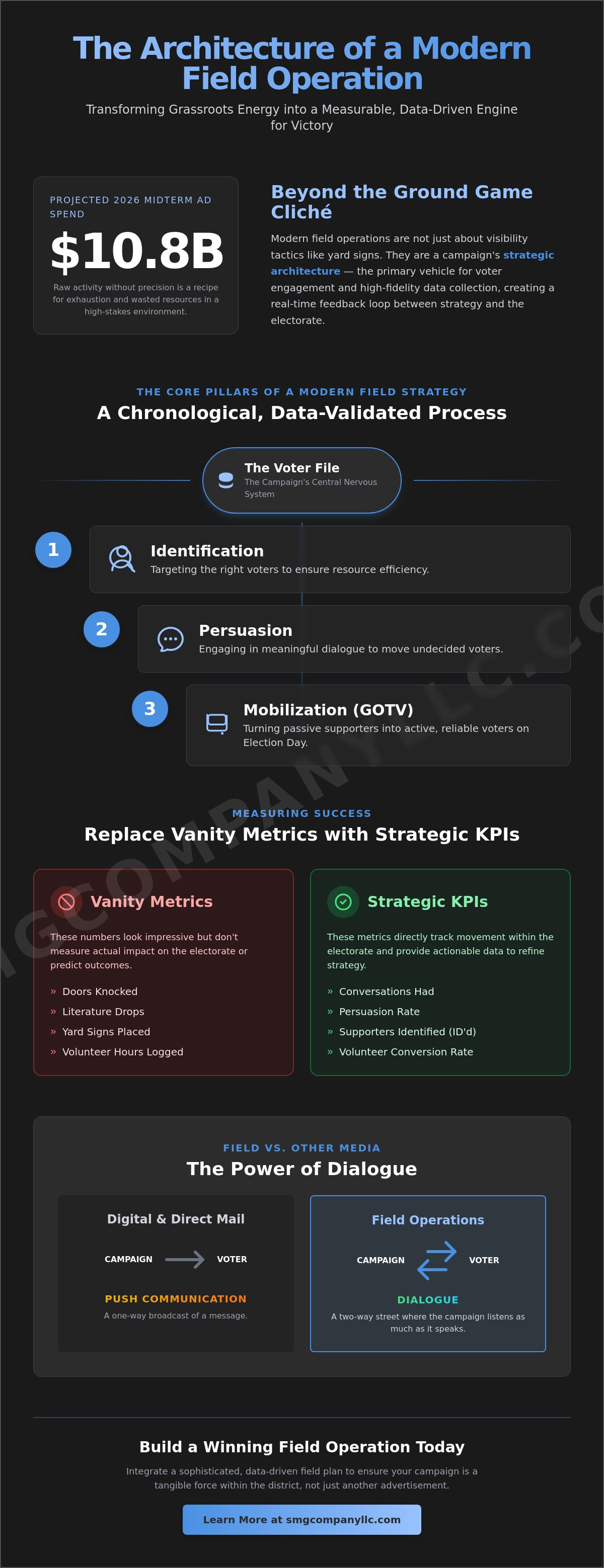
The distinction between field work and other media channels lies in the difference between push communication and dialogue. Digital and mail are essentially broadcast tools; they push a message toward a voter. Field outreach is dialogue-based. It creates a two-way street where the campaign listens as much as it speaks. In an era where 2026 midterm ad spending is projected to reach $10.8 billion, a physical presence provides the credibility that a screen cannot. Integrating a robust field plan ensures that your campaign isn't just another advertisement, but a tangible force within the district.
The Core Pillars of a Modern Field Strategy
Modern field operations for campaigns function through three distinct, chronological phases: Identification, Persuasion, and Mobilization. This progression ensures that resources are never wasted on voters who are either unreachable or already committed. At the center of this architecture sits the Voter File. It serves as the central nervous system of the campaign, containing the historical data and behavioral patterns necessary to predict voter intent. A seasoned Field Director oversees this command structure, ensuring that every volunteer interaction is logged and every metric is tracked with precision. To maintain organizational clarity across complex jurisdictions, many professionals utilize a Political Field Plan Template to standardize their outreach efforts.
Ground efforts achieve maximum impact when they're reinforced by digital advertising for campaigns. This integration creates a multi-touch environment where a voter encounters a candidate's message on their mobile device days before a volunteer knocks on their door. This layered approach builds familiarity and lowers the barrier to entry for a meaningful conversation. If you are looking to refine your ground game, professional campaign management can provide the oversight needed to sync these channels effectively.
Door-to-Door Canvassing: The Front Line
Success on the doorstep begins with strategic turf cutting. We prioritize neighborhoods by distinguishing between high-propensity voters, who require mobilization, and persuasion targets, who require deeper engagement. A winning script moves away from rigid talking points and toward listening points. This allows volunteers to identify a voter's specific pressure points while maintaining the professionalism and etiquette expected of a modern campaign representative.
Phone and Text Banking: Scaling the Message
The evolution of outreach has moved from intrusive cold-calling to targeted peer-to-peer (P2P) texting. This shift allows for high-volume contact without losing the personal touch. We utilize mobile advertising to warm up a district before the field team arrives, making the eventual text or call feel like a continuation of a dialogue rather than an interruption. Voice and text broadcasting tools enable us to scale this message rapidly while keeping the data flow back to the Voter File seamless.
Community Events and Surrogate Deployment
Town halls and rallies are more than just photo opportunities; they're data-collection hubs. Every attendee represents a potential volunteer or a donor whose information must be captured. We strategically deploy local influencers and surrogates to amplify the field message within specific micro-communities. In high-density areas like Newark, the SMG Video Truck serves as a high-visibility field hub, creating a physical presence that anchors the campaign's local operations and draws in undecided voters through professional, mobile messaging.
Data-Driven Field Operations: Leveraging Electorate Analysis for Precision
Field operations for campaigns are often treated as a separate silo from a campaign's analytical core, yet this disconnect is where many organizations fail. A truly effective ground game functions as a high-fidelity data collection engine that informs every strategic decision. By integrating electorate analysis into the field plan, leadership can prioritize resources with surgical accuracy. This creates a continuous feedback loop where raw data from the doorstep is fed back into polling models, refining the campaign’s understanding of public sentiment in real time.
Identifying 'swing' segments is the first step in this optimization process. We look for voter groups that are statistically most susceptible to persuasion through personal contact. Micro-targeting is the surgical application of field resources to specific voter sub-groups. By focusing on these high-leverage segments, we ensure that the campaign is moving the needle where it matters most, rather than shouting into the void of already decided voters.
Voter Modeling and Scoring
We utilize sophisticated voter modeling to assign 'Support Scores' and 'Turnout Scores' to every individual in the voter file. Since state voter files can cost anywhere from free to over $37,000 depending on the jurisdiction, maximizing the value of this investment is paramount. Support scores tell us how likely a voter is to favor our candidate, while turnout scores predict their likelihood of actually casting a ballot. SMG uses this data to ensure no volunteer hour is wasted on 'lost cause' voters who won't support us or 'safe' voters who are already guaranteed to show up. Predictive analytics for 2026 field planning allow us to anticipate shifts in voter behavior before they manifest at the ballot box, giving our clients a distinct advantage in a crowded field.
Real-Time Field Reporting
The days of paper walk-sheets and delayed data entry are over. Modern operations rely on mobile-based data entry that allows for instant strategy adjustments. When a volunteer logs an interaction, that information is immediately available to the central command. This speed allows us to spot emerging trends in voter objections and pivot political messaging services accordingly. With the 2026 trend toward AI-powered strategic voter targeting, having a human-verified feedback loop is what separates a winning ground game from an automated failure. Daily debriefs ensure that the strategic integrity of the operation is maintained, allowing the Field Director to refine scripts and targets based on the latest intelligence from the front lines.
Measuring Success: Field KPIs and Performance Metrics
Field operations for campaigns often fall into the trap of prioritizing volume over value. A campaign can knock on 50,000 doors and still lose if those interactions don't result in meaningful data or persuasion. We distinguish between vanity metrics and strategic KPIs to ensure every hour spent on the ground contributes to a measurable victory. While "Doors Knocked" indicates effort, "Conversations Had" is the true metric of engagement. It represents the actual opportunities to deploy political messaging with precision and record voter feedback.
The most critical indicator of success is the Persuasion Rate. This metric tracks the percentage of voters who moved from "Undecided" to "Supporter" following a field contact. Without this data, a campaign is flying blind. We also monitor the Volunteer Retention Rate. A healthy field operation isn't just about recruitment; it's about building a sustainable, mission-driven force that returns shift after shift. High turnover in your volunteer ranks usually signals a disconnect in leadership or a lack of clear mission. We ensure every interaction is high-quality, as poor contact can actually alienate a potential supporter.
Quantitative vs. Qualitative Metrics
Effective reporting balances raw numbers with qualitative insights. We track the number of new voter IDs, but we also measure the depth of voter sentiment captured. This allows us to quantify "voter enthusiasm" by analyzing the intensity of support recorded during field interactions. These KPIs aren't just for internal tracking; they are the tools we use to hold staff and consultants accountable for real-world progress. If the data doesn't show movement in the electorate, the strategy must change immediately.
The Path to Victory: The 'Win Number'
Every action in the field must be reverse-engineered from the "Win Number" identified in your campaign plan. This number represents the total votes needed to secure victory, accounting for projected turnout and historical data. By calculating the cost-per-voter-contact, we can optimize political campaign budgeting to ensure funds are allocated where they will have the highest impact. As the cycle moves into the GOTV phase, field goals shift from persuasion to mobilization, requiring a total realignment of your KPIs to focus on turnout rather than identification.
Secure your path to victory by engaging SMG for expert campaign management that turns field data into actionable intelligence.
Executing a Winning Field Plan: The Strategic SMG Framework
Execution is where theoretical strategy meets the friction of reality. For field operations for campaigns to succeed, the transition from high-level planning to ground-level activity must be seamless and disciplined. SMG acts as the strategic architect in this process, managing multifaceted field challenges with the precision required in a high-stakes electoral environment. We don't just provide staff; we build a mission-driven infrastructure designed to withstand the volatility of a modern cycle. Central to this is our comprehensive Field Manual, a document that ensures messaging remains consistent across diverse jurisdictions while allowing for local tactical flexibility.
Our framework prioritizes the recruitment and training of a force that understands the gravity of their task. In an era where 2026 midterm spending is reaching record levels, the quality of your ground game is often the only thing that can cut through the noise of a $10.8 billion advertising landscape. We ensure that every volunteer interaction is a professional representation of the campaign's core values, turning grassroots energy into a measurable electoral engine.
Volunteer Management and Training
A supporter is a passive asset, but an operative is a strategic one. Our framework focuses on professional training that moves volunteers up the "Ladder of Engagement." We identify top performers and promote them into leadership roles where they oversee specific micro-turfs. Maintaining morale in a high-pressure field environment requires clear communication and a shared sense of mission. We treat volunteer management as a professional discipline, ensuring that every individual on the ground understands their specific role in the broader path to victory.
The GOTV Operation: The 72-Hour Plan
The final 72 hours of a campaign represent a total shift in operational focus. Persuasion ends and pure mobilization begins. This phase requires immense logistical coordination to execute "Chase" operations, which target identified supporters who haven't yet cast their ballots. In an environment where new legislation like the SAVE Act may impact registration and documentation requirements, having a field team that's briefed on the latest regulatory changes is vital. We orchestrate this final push to ensure every identified supporter actually makes it to the polls, turning data points into hard vote totals.
Why Strategic Leadership Matters
There's a fundamental difference between a staffed field office and a managed strategic operation. A managed operation integrates field data with government relations and public affairs strategy, creating a unified front that influences both voters and stakeholders. SMG provides the seasoned oversight necessary to navigate these complex systems without losing momentum. We focus on the hidden mechanics of influence, ensuring your ground game is a disruptive force that challenges the status quo. To secure your electoral objectives, partner with SMG to build your 2026 field strategy and transform grassroots energy into a winning electoral engine.
Mastering the Strategic Ground Game for 2026
Victory belongs to those who view the ground game not as a series of isolated tasks but as a cohesive, strategic system. We've established that field operations for campaigns serve as the primary architecture for voter engagement, providing the high-fidelity data necessary to refine high-level strategy in real time. By moving beyond vanity metrics and prioritizing the transition from persuasion to mobilization, your campaign can ensure that every volunteer hour contributes directly to hitting your win number.
SMG acts as a seasoned insider for candidates and organizations nationwide. We've managed campaigns in over 40 states, bringing deep expertise to local, state, and federal elections. Our framework pairs a grounded focus on community leadership with the innovative use of data and mobile advertising to create a disruptive force in the electorate. This methodical approach provides the stability and momentum needed to navigate the complexities of a modern political environment.
Secure Your Path to Victory with SMG's Strategic Field Management and build an operation that transforms grassroots energy into a measurable electoral win. Your path to leadership starts with a ground game built for precision.
Frequently Asked Questions
What is the difference between field organizing and field operations?
Field operations for campaigns represent the strategic architecture and logistical systems, while field organizing is the human-centric execution of those systems. Operations focus on data management, infrastructure, and the command structure. Organizing focuses on building relationships and volunteer capacity. Both must work in tandem to ensure that every contact is logged and every resource is utilized with maximum efficiency.
How many volunteers do I need for a successful local campaign field operation?
The number of volunteers required is determined by your "Win Number" and the total voter contact attempts needed to reach it. A local campaign should aim for a volunteer-to-voter ratio that allows for multiple touches per household. If your goal is to knock on 10,000 doors, you'll need enough operatives to cover that turf within your specific timeline while accounting for shift frequency and volunteer retention rates.
Which is more effective: door knocking or phone banking?
Door knocking is generally more effective for persuasion, while phone and text banking are superior for scale and mobilization. Face-to-face interactions build higher levels of trust and allow for deeper dialogue. However, digital tools like voice and text broadcasting enable a campaign to reach thousands of voters in the time it takes to walk a single block, making an integrated approach essential for modern victory.
How do I track the performance of my field team in real-time?
Real-time tracking is achieved through mobile-based data entry systems that sync directly with a centralized voter file. This allows field directors to monitor "Conversations Had" and "Persuasion Rates" as they happen. By moving away from paper sheets, leadership can identify underperforming turf or emerging voter objections immediately, allowing for rapid tactical adjustments that keep the operation on track toward its goals.
What is a 'Win Number' and how does it affect field strategy?
A "Win Number" is the specific number of votes required to secure victory, typically calculated as 52 percent of the projected turnout. This figure dictates your entire field strategy by defining exactly how many supporters you must identify and mobilize. Every knock, call, and text is a calculated step toward hitting this numerical threshold before polls close on election day.
How much of my campaign budget should be allocated to field operations?
Budget allocation for field operations for campaigns typically ranges from 20 to 30 percent of the total campaign spend, though this varies by jurisdiction and candidate needs. High-stakes races often prioritize field spending to ensure that expensive media buys are reinforced by personal contact. Professionals should evaluate their cost-per-voter-contact to ensure that ground resources are delivering a high return on investment compared to broadcast channels.
Can digital tools replace traditional field operations?
Digital tools cannot replace traditional field operations; they serve as a force multiplier for physical outreach. While digital advertising builds name recognition and warms up a district, it lacks the persuasive power of a personal conversation. A credible campaign requires a physical presence to validate its messaging and build the community leadership necessary for long-term electoral success and civic trust.
What is GOTV and when should it start?
GOTV stands for Get Out The Vote, and it is the final mobilization phase focused solely on turnout. This operation should begin as soon as early voting or mail-in balloting starts in your district, intensifying into a massive 72-hour push before the general election. The goal shifts from persuading undecided voters to ensuring that every single identified supporter actually casts their ballot.
Comments